


It can feel hard to stay hopeful at the moment.
Every week seems to bring another reason to worry: war, climate, political division, financial uncertainty, personal worries. The news cycle is relentless and social media often amplifies whatever feels most alarming or enraging. When good things happen, they struggle to compete with the latest crisis.
These concerns are very real and I’m not suggesting we should ignore them. But there’s another reason the world can feel so bleak: our minds are naturally drawn towards focusing on what’s wrong.
We all have a built-in tendency to pay more attention to the difficult parts of life, rather than the good moments. This instinct, known as the negativity bias, was crucial to our ancestors’ survival. Paying attention to unpredictable dangers from predators or rival groups often meant the difference between life and death. If they hadn’t focused on the risks, we wouldn’t be here now.
But this same tendency helps explain why our minds still fixate on what’s wrong – whether it’s a harsh email, a challenging meeting, something awkward we said, or the latest troubling headline. Meanwhile, we often overlook what’s gone well. We get stuck in cycles of worry and frustration, automatically jumping to the negatives without stopping to appreciate the good stuff.
This is where gratitude comes in. Alongside our natural focus on what’s wrong, we can also consciously direct our attention to what’s going right. When we choose to actively see the good in our lives, it helps us to get out of ‘autopilot’ mode, counteract the negativity bias and notice more of the little things that make life big.
But seeing the good shouldn’t be confused with forced positivity, and knowing the difference really matters.
Seeing the good
When I first heard about the idea of keeping a ‘gratitude journal’, I was very sceptical. As a British bloke in midlife, the idea of sitting down to write about what I was thankful for each day seemed contrived, even cringey. I remember thinking, how could this possibly help?
Then when I saw the research on the benefits of gratitude, I became more open-minded. Scientists had found evidence that simple gratitude exercises can help people feel happier, improve their sleep and reduce their stress. So I got curious. Maybe it was worth trying out?
For a few minutes each evening, I started jotting down three good things about my day: little things I’d enjoyed, friendly conversations, something that made me laugh or smile, that sort of thing. Like many of my experiments to make life happier, this felt unnatural at first. Although I’d always considered myself an upbeat person, I was surprised to discover how rarely I’d actually been paying attention to what was good.
After a few days, though, the awkwardness faded and something else started to take its place: appreciation. Instead of focusing only on what had gone wrong or worrying about tomorrow, I found myself remembering good things I would normally have overlooked. This also encouraged me to keep more of an eye out during the day for things that gave me a boost – like the view across the park on my way to work, a decent cup of coffee, or a kind word from a colleague.
This practice didn’t stop the difficult days. But it did help me see that not everything was falling apart. Even on the worst days, good things still happen.
This is the key point. Gratitude isn’t about ignoring reality – it’s about seeing reality more fully. The bad stuff often sticks naturally, while the good tends to slide away. By regularly noticing what we’re thankful for, we can train our minds to hold on to positive experiences for a little longer.
This isn’t just something to do privately in our own heads. I started experimenting with questions that encourage others to look for good things too. So instead of asking my kids the usual “How was your day at school?” – to which the usual answer was “Hmm, okay” – I’d ask, “What went well today?” Or instead of starting a work meeting with a list of issues, we’d ask, “What’s gone well recently?”
These subtly different prompts sparked more meaningful conversations. My kids started sharing funny or memorable things from their day. Colleagues began to mention things that were going really well, not just problems that needed fixing.
Crucially, none of this was about avoiding the difficult stuff. My kids still complained about boring teachers and our team still had plenty of issues to get through. But we also made time to recognise the good stuff.
The problem with forced positivity
But this is where we need to be very careful. Encouraging gratitude can really help, but it can also be misplaced – and trying to force it usually backfires.
A few years ago I was running a workshop on the science of happiness. I’d invited participants to think of something they were thankful for and share it with the person next to them. As usual, there was a warm buzz in the room as people told their neighbours about a funny moment at breakfast, an unexpected compliment from a friend, or a kind stranger who held the door so they made their train on time.
As the room filled up with enthusiastic noise, I spotted a woman towards the back who hadn’t found anyone to talk to, so I wandered over to say hello. As I approached, I could sense she was annoyed and would rather be somewhere else. Anywhere else!
“Honestly,” she said, “there’s nothing to be thankful for. It’s all awful. I don’t need to be told to look on the bright side, like that will magically fix my problems.”
I took a breath. I felt a bit defensive, but also sensed a learning opportunity – for both of us. Rather than trying to help her see things differently, I listened and reassured her that her feelings made sense. I agreed that forced positivity isn’t helpful.
Too often, happiness is presented to us as a picture-perfect life – the kind that’s impossible to live up to. We’ve all seen those cheesy stock images of people leaping joyfully on beaches and memes telling us to “just think positive”. These simplistic nudges can feel more like insult than inspiration, especially in tough times. Equating happiness with contrived positivity doesn’t leave room for the messiness of life.
Take those popular platitudes: “Everything happens for a reason” or “You’re exactly where you need to be”. If, like me, you find messages like these uncomfortable, don’t worry – that doesn’t make you a pessimist. These clichés misrepresent the reality of life, including its inevitable ups and downs.
Imagine telling someone reeling from a painful loss, a cancer diagnosis or a significant setback that “everything happens for a reason”. What may be intended as encouragement can instead feel hollow – like their suffering isn’t acknowledged. If we sideline people’s difficult emotions, we’re not helping them move forwards. We’re asking them to ignore the very feelings they need to process in order to heal.
Pain doesn’t disappear because we pretend it isn’t there. Real resilience comes not from bypassing suffering, but from allowing it to be part of our story – and learning how to live alongside it.
As the exercise drew to a close, I thanked the woman for being honest and said, “It sounds like things are really tough right now.” To my surprise, she looked up with a brief but genuine smile and replied, “Well, I guess I can be thankful my liver is still working.” Even on a dark day, she’d found a tiny ray of light. But it was grounded in realism, not wishful thinking.

Realistic optimism
In real life, good things and bad things coexist. Small moments of joy live alongside other moments of struggle, pain or heartache. These pleasant moments are important, but they don’t suddenly fix things.
To make life happier, we need to see the good while also recognising what’s wrong. This is what I mean by realistic optimism – a balanced approach that acknowledges challenges while still finding hope, rather than blindly sugar-coating tough situations.
Realistic optimism avoids two traps. One is cynicism, where we assume the worst and detach ourselves from the possibility of change. The other is wishful thinking, where we try to manifest a better future without properly acknowledging reality or taking meaningful action.
Although our beliefs do shape how we interpret the world, just wishing for something won’t magically change the physical reality around us. However much I might try to ‘manifest’ a loved one’s recovery from cancer, this won’t make it so. It’s almost certainly better to help them seek the medical care they need.
Coping requires more than just hoping. It requires action.
This is where the work of my friend Dr Chris Johnstone on Active Hope is so helpful. Chris noticed that people often want to feel confident things will turn out well before they act. But if we wait for that feeling of confidence, we can get stuck, especially when the odds don’t look good.
Active Hope starts somewhere different. First, we acknowledge our reality and take in a clear view of how things are – noting our fears and struggles rather than suppressing them. Then we choose our direction, identifying our hopes for how we’d like things to change or how we’d like to behave. Finally, we take steps forwards, however small, with purposeful actions that move us in that direction.
This kind of acceptance doesn’t mean resignation or tolerating a bad situation. It’s about seeing things clearly and honestly, without glossing over or slipping into denial. Taking action doesn’t mean we can fix everything instantly. But we can always ask: “What’s one thing I can do today to make this situation a bit better?”
This combination of acceptance and action is at the heart of realistic optimism. We’re rooted in reality but powered by possibility. Even in the face of adversity, we can do something.
The possibility of ‘and’
One of the most powerful ways to practise realistic optimism is what the psychologist and resilience expert Dr Maria Sirois calls the ‘possibility of and’. This mindset encourages us to hold two truths at the same time. After acknowledging the reality of our situation, we also make room for what she calls a ‘balancing truth’.
For example:
“I’m struggling and I’m doing my best.”
“Life is hard and there is beauty in it.”
“This is not what I wanted and I can find a way forwards.”
Or, from my own life recently:
“I’m worried about Mum being in so much pain and I’m grateful for the support she has nearby and the wise choices she’s making.”
This ‘and’ mindset helps us stay realistic while maintaining a sense of momentum. We develop more flexibility by recognising that difficult feelings and positive possibilities are not mutually exclusive. Instead of trapping us in ‘all-or-nothing’ thinking – where we’re either thriving or failing – it gives us permission to exist in the gritty, in-between space of being human.
This isn’t about replacing a painful truth with a positive one. It’s about broadening our frame to name the challenge honestly and then ask what else is true. What strength, support, beauty or opportunity can coexist with the difficulty?
If you’re feeling overwhelmed by work, the balancing truth might be: “I’ve met tough deadlines like this before.” If you’re struggling with loneliness, it might be: “There’s someone I can reach out to.” If you’re worried about the world, it might be: “There are still people working every day to make things better.”
Then comes the action. Not a grand gesture, just the next small step. Prioritise one task, make one phone call, send one message or take one breath. Donate, volunteer, speak up, rest, apologise or ask for help. Do whatever moves you gently in the direction of the life you want, or the world you want to contribute to.
We can train the mind to hold space for both struggle and hope. Life is rarely just terrible or wonderful. Very often it’s both.
Keep it real and see the good
Holding two seemingly opposing thoughts in our heads at the same time is one of the hardest, yet most important, skills for happier living.
Things were difficult.
Things went well.
Things will be difficult.
Things will go well.
All four of these statements are usually true at the same time. Focusing on just one is incomplete. The messy, grey areas of life are where the real growth happens.
So realistic optimism doesn’t ask us to ignore what’s wrong. It doesn’t ask us to smile through pain, tolerate injustice or pretend everything happens for a reason. But it also doesn’t let our negativity bias, or the endless stream of bad news, convince us that darkness is the whole story.
It invites us to see the good alongside the bad, not instead of it. We can hold on to small moments of light, even when the bigger picture feels heavy. We can face up to what’s wrong and still look for constructive ways forwards. That’s not naïve wishful thinking. It takes courage and strength to stay open-hearted in an uncertain world.
So the real challenge is not to be more positive. It’s to become more balanced, more honest and more hopeful. To acknowledge what’s difficult without losing sight of what’s good. To accept reality while still taking action.
Life is hard and there is so much beauty in it too. We can choose how to respond.
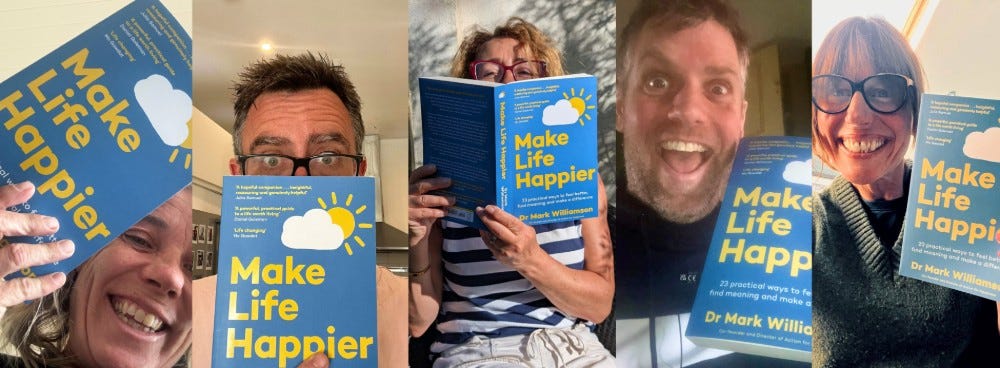
Dr Mark Williamson is CEO of Action for Happiness. His Sunday Times #1 bestselling book Make Life Happier shares 23 practical ways to feel better, find meaning and make a difference.
Today I’m grateful that I received this article. I often find I receive the things I need when I need them even if I didn’t know at the time I needed it. As I was reading the article this morning, I had several aha moments and recognized the advice as something that would be helpful not only for me, but for a number of people in my circle as we’ve been dealing with change at work and in our personal lives. I’ll be sharing the article with everyone and hoping they find some connection to the concept of realistic optimism. Thank you!
I’ve been a little overwhelmed of late by difficult stuff with family ill health and have lost my practice of noticing and writing three things to be grateful for each day. You have reminded and inspired me to pick it up again. Thank you.